
The Table
the final chapter

A cold night in the middle of March, 2017. The 1880s sanctuary of the Italianate church on Second Street in Amherst, Virginia is filled to overflowing, every pew filled and people on the balcony walkway above a red-carpeted proscenium where a pulpit once stood, now a simple stage. The church has been de-sanctified and is being used as a community art center. The crowd is awaiting the entrance of a young poet who grew up attending the Amherst County Public Schools. Molly McCully Brown is 26 and her book of poetry The Virginia State Colony for Epileptics and Feebleminded, has gotten a boxed and starred review in Publishers Weekly, soon will be featured in the New York Times and Molly will be interviewed by Terry Gross of NPR’s Fresh Air. The air crackles with anticipation and the late-winter static electricity of pulled sweaters. The community has come together to celebrate this remarkable achievement at the community art center in the middle of this town of 2000 souls. Many came because they have long wondered about “The Colony,” which figures prominently in the County’s history. But also, Molly is something of a local phenomenon and folks have come out to celebrate her. Born with cerebral palsy, she excelled in school and at sixteen went off to college at Bard’s Simon’s Rock and later to Stanford. Her parents arrived to teach at Sweet Briar College when she was a child and she and her brother and sister grew up as near-siblings to our three children. Up in front I see Molly’s first grade teacher and some of her grade-school friends. Along the side are members of the Sweet Briar College community where she grew up. There are others who have read about the event in the newspaper. Everyone here is also celebrating the remarkable feat of being able to gather in this building at all. Five years earlier, Amherst County, the owner of the building, had decided to raze the building.
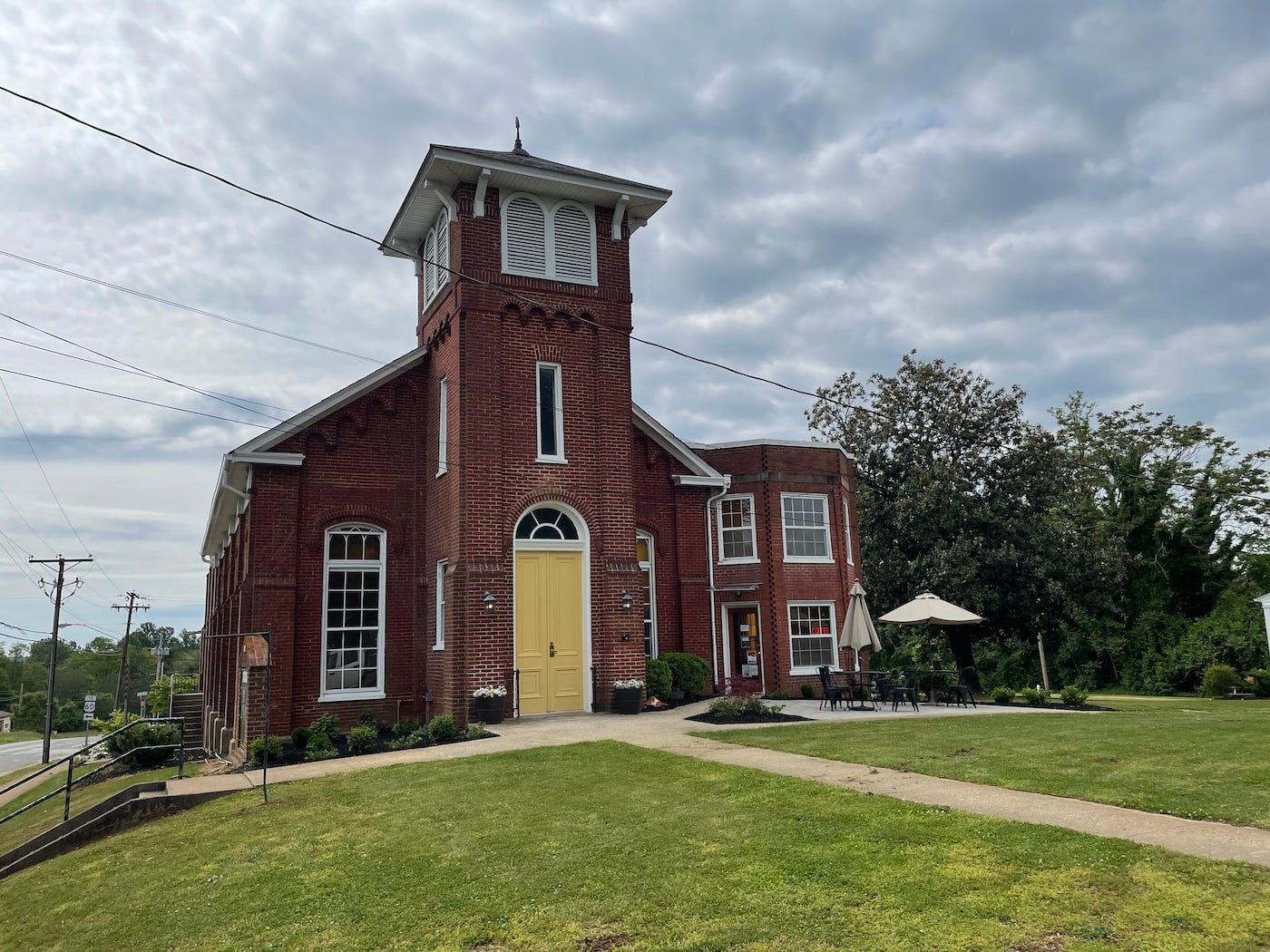
Six months after a Derecho blew through Central Virginia, snapping off three-foot diameter trees and damaging hundreds of buildings, a story appeared in the Amherst New-Era Progress that said Amherst County was planning to tear down the Baptist Church in the center of town. This building had been abandoned by its congregation and in 2006 had been purchased by the County for $350,000 because it sat just along Second Street across from the County Administration building. Six years later, when the powers-that-be discovered how much it would cost to bring it up to code for governmental use, they threw up their hands and decided to tear it down and use the land it occupied as a parking lot. No kidding, that is really what they said.
I saw the story in the Amherst New Era Progress and forwarded it to Suny Monk, my collleague at VCCA for many years, by this time retired. She responded a few hours later with a single line: Let’s make trouble. I responded, Hell yes, and by the end of the day I had sent the link on to six other people, asking them to join us at a strategy meeting to discuss what could be done. Steve Martin, a local attorney, offered his Main Street office as a meeting place. One of the six also invited a person from neighboring Nelson County who had worked on a similar project for an abandoned school. From this initial meeting, we put together a list of potential advocates who could join us. Steve Martin drafted a letter of complaint to the County Administrator and soon we assembled a group of citizens and descended on the Board of Supervisors meeting to protest their decision to destroy the building. Within a few months we had assembled an ad-hoc board of directors of artists, arts administrators, an attorney, a graphic designer, a developer specializing in repurposing old buildings, a local chiropractor, and an historic preservationist. Working with the County Administrator and the one member of the Board of Supervisors who saw potential value in the second oldest building in the town, by the end of the year we secured permission to undertake a trial run the coming summer to demonstrate the building’s potential as a community art center.
September, 2013. The organization now called Second Stage Amherst, has secured a 501c3 designation from the IRS as a non-profit organization and has just completed a summer of programming. Nineteen events have been presented: a theater showcase by the best theater company in the region, a Grammy-nominated Renaissance ensemble, a magician, jazz classics, bluegrass and even a drumming circle. Early on, Sheila had casually mused that it would be really nice if a farmer’s market could be held on the grounds under the 300-year-old live oak. The idea was such a brilliant observation that everyone who heard it thought it had been their own idea and this had been made manifest, too, every Thursday from 3 to 6. Local businesses and individuals ponied up seven grand to support concerts; ticket sales brought in three thousand dollars; by the end of the summer, local farmers had walked home with nearly forty thousand. By any reckoning, the trial run had been a raging success.
March 2014. County Supervisor John Marks made a motion to demolish the building. “Let me just say this: I am not willing to spend taxpayer money to redo that church. I stand by my position that the land is more valuable than the building itself,” he said to a local newspaper reporter. Sherese Gore, that young reporter, was the only reporter for the local newspaper, yet her seriousness and professionalism were a continuing source of support to our efforts. She wrote a series of articles chronicling the unfolding story, which was so important to informing the community, that I tried my best to have her editors nominate her for a Virginia Press Association award. Thanks to her work and to the good will generated by the summer of programming, John Marks’s motion did not carry.
In May, another motion to raze the building was put forward and this timing allowed the County to deny our use of the building for the summer of 2014, although they could not find a way to deny us the use of the parking lot to continue the farmer’s market. Again, with support of local businesses, we used that permission to book musicians to play during the markets each week. We even got a contribution from Claudia Tucker, our one supportive Supervisor, and her husband Bill, to help finance the musicians. This continuity undoubtedly helped anchor the organization in the community.
Thanks to the work of Sandi Esposito, our historic preservationist board member, a field representative of Preservation Virginia wrote to the Amherst County Supervisors in the fall encouraging them to re-purpose the building. “By reusing historic structures, we are being good stewards of buildings that are witnesses to history,” she wrote. A representative of the Virginia Department of Historic Resources wrote to say the building had potential to be put onto the National Register of Historic Places. Our board and a group of volunteers cruised the farmer’s market each week circulating a petition to save the building. We accumulated 2000 signatures. A new County Administrator had been hired who recognized the historic value of the property and he had included the building in an assessment of county property space needs. Our ongoing nemesis, Supervisor John Marks, made a motion to remove the church from that assessment. Again, we marshaled supporters to crowd the Board of Supervisors meeting to advocate for saving the building, this time using our petition and the support of the Department of Historic Resources.
Over the next weeks, Suny and I had many meetings with the new County Administrator, Dean Rodgers, former military, a JAG attorney. Not one to be pushed around by the Supervisors, he helped us negotiate the political territory. Then, in November, we marshaled supporters to work on the campaign for the County Supervisor seat of one of our staunchest opponents. Our candidate, Kenneth Campbell, was the man who had worked for many years as the County Building official. Rotting fascia and sagging gutters had given three of the five Supervisors ammunition to claim the building was unsafe and so we had asked for an official opinion. I accompanied Ken as he did an assessment of the structural soundness of the building, hovering beside him at every turn, suspicious, not knowing what his sentiments were. He found the building to be remarkably structurally sound. Despite this, a Supervisor that will go unnamed quietly pushed Ken to claim otherwise. Incensed over this, and now of a certain age, Ken retired as Amherst County Building official and ran against the man who had asked him to lie.
Ken’s election in November shifted the tide — the Supervisors knew very well the advocates of Second Stage had worked hard to insure Ken’s victory. Shifting the tie-breaking vote from a no to a yes, proved too much. In December, the Supervisors voted to approve the contract Dean Rodgers had helped us forge: a five-year lease at $10 per year with the agreement we would spend $10,000 per year on upgrades and maintenance of the building. Each party had an opt-out option, but I had a plan to beat that. Using my knowledge and experience from two decades at VCCA, I began writing grants to support the organization. Imagine an organization working to save a lovely nineteenth century building threatened with demolition, while at the same time creating a community art center in a rural, impoverished town that had never had one. Every grant I wrote was approved.
I then agreed to lease one of the ancillary rooms — the one I chose was the former Pastor’s Study — to create an art gallery as a way of kick-starting a lease program that might provide another income steam for the organization. A yoga teacher signed on to lease a large upstairs room and a jeweler took the tiny, secretary’s office with the big glass window. Funders ate it up. By the time we held the grand opening in August, we had already invested fifty thousand dollars in upgrades, securing our place for the entire five-year lease: new accessible bathrooms, roof repairs, fresh paint throughout the entire building, a new HVAC system, theater lights and a used sound system; a local paint company even re-painted the eighteen-foot-high pressed tin ceiling as a donation.
In this transformed space, Molly rises from her seat at the front of the room, takes her father’s hand and steps up onto the not-yet replaced red-carpeted stage. The house lights go down and the new theater lights come up. The crowd quiets. Seated in a hard-backed chair, Molly leans into the microphone.
TRANSUBSTANTIATION
It’s the middle of the night. I’m just a little loose on beer, and blues,
and battered air, and all the ways this nowhere looks like home:
the fields and boarded houses dead with summer, the filling station rowdy
with the rumor of another place. Cattle pace the distance between road
and gloaming, inexplicably awake. And then, the bathtubs, littered in the pasture,
for sale or salvage, or some secret labor stranger than I know. How does it work,
again, the alchemy that shapes them briefly into boats, and then the bones
of great felled beasts, and once more into keening copper bells, before
I even blink? Half a mile out, the city builds back up along its margin.
Country songs cut in and out of static on the radio. Lord, most of what I love
mistakes itself for nothing.
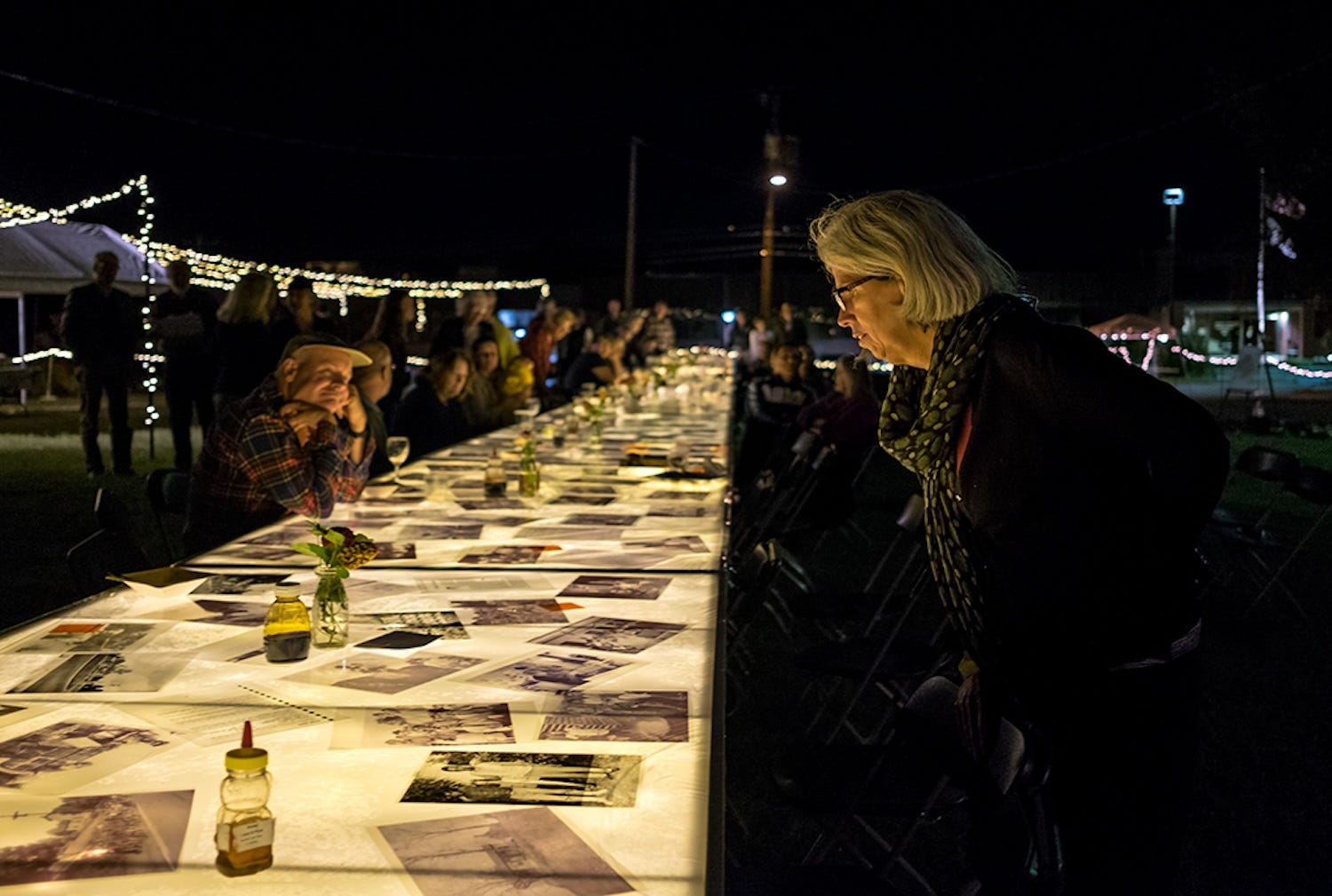
At the tail end of that summer, in mid-September, we produce a coup-de-grace, of sorts. Donald Trump has sowed the evil seeds of discord throughout the country. Our board was decidedly split politically, but also recognized it remained possible to sow our own seeds of cooperation and goodwill on a local level, to insert antibodies into the vast Trumpian virus. Having worked over several months, with plotting and planning directed like a military operation by Suny, on this warm clear evening, exactly one month after the Unite the Right rally fifty miles north in Charlottesville, we host a community dinner on the big lawn alongside the building. We decide the event will be called Come to the Table. We have worked hard to bring together constituencies from the black community, the Latino community, and the Monacan Indian community that had lived in the county before any of the others of us had come. Each constituency has prepared part of the meal. We have spent hours in the archives of the County Historical Museum, the Monacan Nation Museum and Sweet Briar College archives to gather photos to sketch the historical picture of the county. The Chilean artist Edgar Endress, who had lived for a while in Lynchburg, created a slide show of these photos that would be projected on a big screen. I have designed and hired a skilled carpenter to help me create the table at which the community will gather.
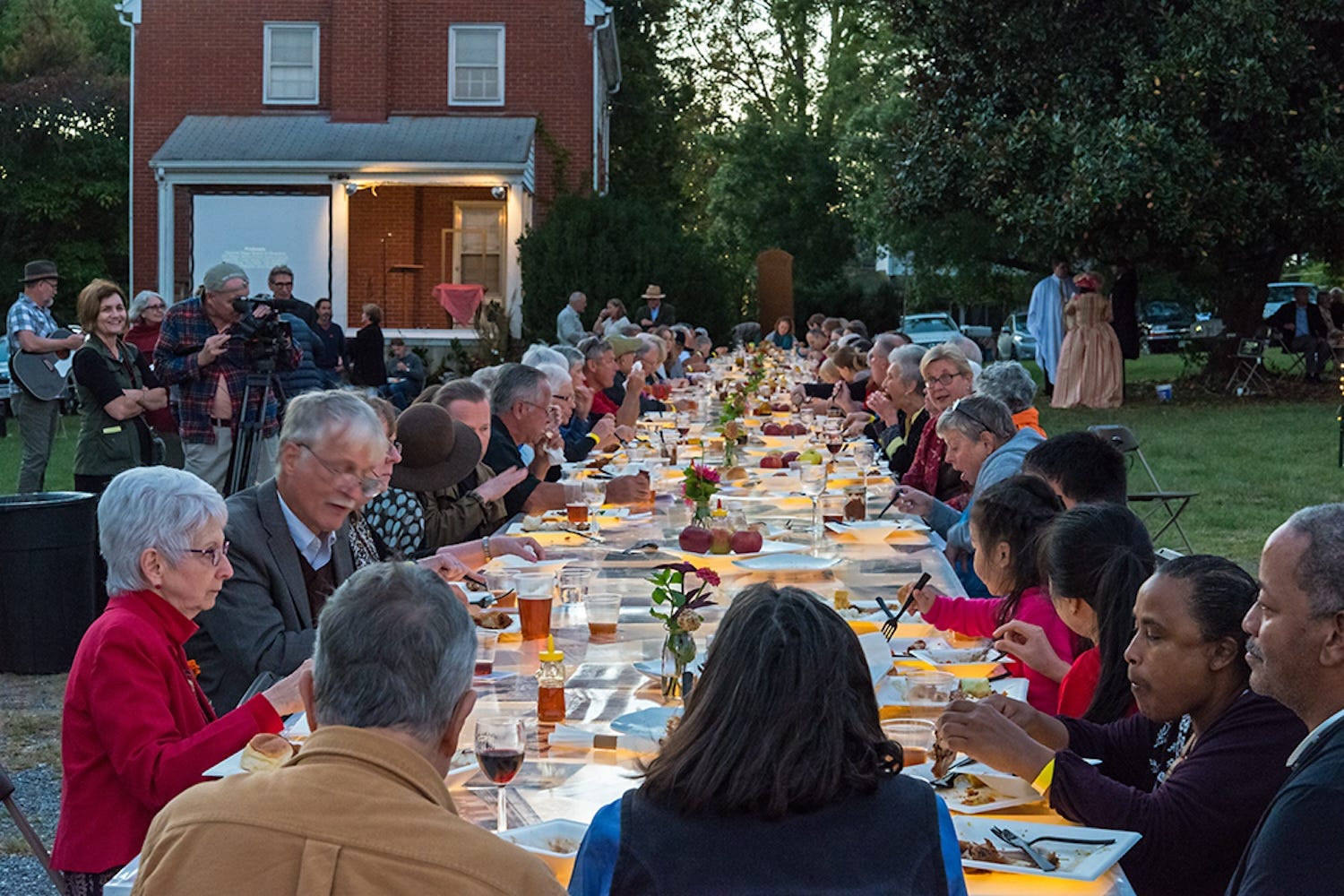
Here is the final image: Under an enormous magnolia, a light table one hundred feet long and four feet wide stretches across the lawn. It is lined with more than a hundred seats filled by members of the community. Scattered across the expanse of white plexiglass lighted from below, are three hundred 8 x 10 black and white photos printed on transparencies, so that, as the daylight fades, the light from below transforms them from what appeared to be regular photos into something more like magic lantern slides. People file past the food tables, heaping on fried chicken and collards and a Peruvian version of Brunswick Stew and gather at the table to eat. There are far more people than places. Under the looming magnolia I see Pat, the graphic designer whose work has made us look impressively professional and her husband Michael, another board member. Kelvin Brown, the town’s first African-American police chief, holds the cake he won in the cake walk. I see Sheila across the way talking with Kenneth Branham, former chief of the Monacans who, I discovered in my conversations with him at the Monacan Museum, was born only a few hours before I was. Off to the side, I see Suny talking with Claudia and Bill Tucker, and there, beside them, I see John Marks, the Supervisor who so assiduously tried to raze the building. He is speaking animatedly to the other three and his face is lit up with what can only be described as genuine happiness.
What a beautiful struggle and tale of persistence and networking to bring a community together. Thanks for sharing.
"[Suny Monk] responded a few hours later with a single line: Let’s make trouble." This was — and, indeed, turned out to be — what John Lewis would have called "good trouble." Thanks for recording and retelling the history brought about by so many of your dedicated friends and neighbors..